


Step 1
1 in 3 cycles may not ovulate. Know if you did.
Lorem ipsum dolor sit amet, consectetur adipiscing elit. Ut porta pulvinar arcu.


PdG Ovulation Confirmation Test
You are not imagining it.
Your body may be asking for more fluids before you feel seriously thirsty.
THE TEST
A clear answer, at home.
FSH is the hormone that rises as your body moves through menopause. This test reads it — so the changes you've been feeling have something measurable behind them.
The same biomarkers used in clinical settings.

Pregnanediol Glucuronide (PdG)
Confirms ovulation actually happened, not just that it was coming.
LEARN MOREEasy to use, quick to read, and discreet.
Designed with clinical-grade methodology for dependable results.


OVULATION CONFIRMATION
PdG is the urine marker for
progesterone — a signal
that ovulation has occurred.
5 µg/mL
5 µg/mL
5-10
minutes results ready

Practical guidance
Easy to use.
Easy to understand.
Everything you need to take the test, understand the result, and know what to do next.
Step 2
Wait 5-10 minutes
Step 3
Compare Strips


This product is not intended for the diagnosis, cure, mitigation, prevention, or treatment of a disease or condition. The product is not a substitute for professional medical advice, clinical diagnosis, or treatment.
voices
Real people. Real clarity.


Emily R.
Verified Buyer
I was already using ovulation strips, but I wanted to know if I had actually ovulated afterward. This made that part much easier. I tested in the morning for several days and finally got my positive.
Lauren M.
Verified Buyer
The test is simple to use, but definitely read the instructions because the lines work opposite from what I expected. Once I understood that one line means positive, it was very straightforward.
Rachel T.
Verified Buyer
I’ve been tracking with OPKs for a while, but they only tell me that ovulation may be approaching. I liked having another test afterward to help confirm that it actually happened. The strips were easy to dip and the results were clear.
Amanda K.
Verified Buyer
I liked that the box comes with six tests, so I didn’t feel like I was going to run out halfway through testing. I used one each morning and stopped when I got a positive. Very convenient for home use.
Jessica P.
Verified Buyer
I thought PdG testing would be complicated, but it really wasn’t. I collected my first morning sample, dipped the strip, laid it flat, and checked the result after a few minutes. The instructions made the process easy to follow.
Megan S.
Verified Buyer
My cycles can vary a little month to month, so I wanted more information than just predicting my fertile window. I like that this is focused on confirming ovulation afterward instead of trying to predict it. I’ve started using it across multiple cycles because it helps me see patterns more clearly.
IN THE BOX
Everything you need.
A look inside the kit, and how it works.

BUNDLES
Pairs well with
Connect the dots with complementary tests our customers often reach for — with savings to match.
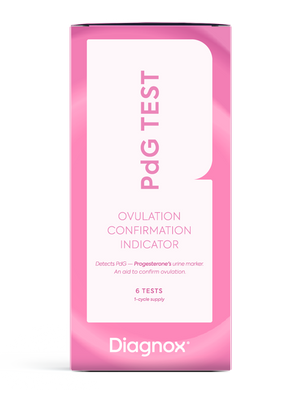
PdG Ovulation Confirmation Test
A regular period doesn't prove you ovulated. This at-home PdG test reads progesterone's urine marker, so you can confirm ovulation actually happened.

UTI Test Strips
Discover the Urinox-UTI test for quick, reliable UTI screening right at home! This easy-to-use, 2-parameter UTI test kit detects both leukocytes and nitrite levels in...
Questions
The ones we hear most often.
LEARN
Care to know.
Know to care.
We believe sharing knowledge is a form of care — knowledge that guides us to look after ourselves and the people around us. Read, watch, or listen at the depth you want.
How to Use Your At-Home UTI Test.
Reading Your FSH Results with Confidence.
Clinical Science Behind At-Home Testing.
The Diagnox Story: Care Starts at Home.
Women's Health: Questions Worth Asking.
Understanding Biomarkers in Plain Language.
