


Step 1
1 in 3 cycles may not ovulate. Know if you did.
An at-home PdG test that helps confirm whether you actually ovulated this cycle. A few minutes each morning, and a clearer picture of what your body is doing.


PdG Ovulation Confirmation Test
Doing everything right.
Regular periods don't always mean ovulation. The app, the sticks, the timing - and still wondering whether your body did its part this month.
THE TEST
A clear answer, at home.
After you ovulate, your body makes progesterone and breaks it down into PdG, which shows up in your urine. When PdG runs high, it's a sign ovulation really happened, not just that it was on its way.
The same biomarkers used in clinical settings.

Pregnanediol Glucuronide (PdG)
Confirms ovulation actually happened, not just that it was coming.
LEARN MOREThe Diagnox PdG Test is an at-home ovulation confirmation test. It detects pregnanediol glucuronide (PdG), the urine form of progesterone, at 5 µg/mL or higher, as an aid to confirm ovulation.
- When to start: your cycle length minus 12 (day 16 of a 28-day cycle), or 5 days after your OPK peak
- How often: one test each morning until you get a positive, up to 6
- Sample: first-morning urine, dipped for at least 15 seconds
- Results: read at 5–10 minutes, not after 10
- Reads opposite: one line = positive, two lines = negative
- Pack: 6 individually sealed strips, enough for one cycle
This test reads opposite.
When PdG is high, the test line disappears. One line means positive. Two lines mean negative, no matter how faint the second line is. Studies show PdG closely tracks blood progesterone.¹


OVULATION CONFIRMATION
Ovulation leaves a trace. PdG is how you see it.
5 µg/mL
about 5 days
5-10
minutes results ready
¹ Ecochard R et al., Steroids, 2013. ² Prior JC et al., PLOS ONE, 2015: over a third of seemingly normal menstrual cycles may be anovulatory.

Practical guidance
Easy to use.
Easy to understand.
Everything you need to take the test, understand the result, and know what to do next.
Step 2
Wait for 5 minutes
Step 3
Read the result


This test detects PdG at 5 µg/mL or higher as an aid to confirm ovulation. It isn't a pregnancy test or birth control, and it can't tell you when you're fertile. Talk to your provider if your cycles are irregular or you have questions.
voices
Real people. Real clarity.


Emily R.
Verified Buyer
I was already using ovulation strips, but I wanted to know if I had actually ovulated afterward. This made that part much easier. I tested in the morning for several days and finally got my positive.
Lauren M.
Verified Buyer
The test is simple to use, but definitely read the instructions because the lines work opposite from what I expected. Once I understood that one line means positive, it was very straightforward.
Rachel T.
Verified Buyer
I’ve been tracking with OPKs for a while, but they only tell me that ovulation may be approaching. I liked having another test afterward to help confirm that it actually happened. The strips were easy to dip and the results were clear.
Amanda K.
Verified Buyer
I liked that the box comes with six tests, so I didn’t feel like I was going to run out halfway through testing. I used one each morning and stopped when I got a positive. Very convenient for home use.
Jessica P.
Verified Buyer
I thought PdG testing would be complicated, but it really wasn’t. I collected my first morning sample, dipped the strip, laid it flat, and checked the result after a few minutes. The instructions made the process easy to follow.
Megan S.
Verified Buyer
My cycles can vary a little month to month, so I wanted more information than just predicting my fertile window. I like that this is focused on confirming ovulation afterward instead of trying to predict it. I’ve started using it across multiple cycles because it helps me see patterns more clearly.
IN THE BOX
Everything you need.
A look inside the kit, and how it works.

BUNDLES
Pairs well with
For when your period's due. Pair with our Early Detection Pregnancy Test, so the next step is ready when you are.
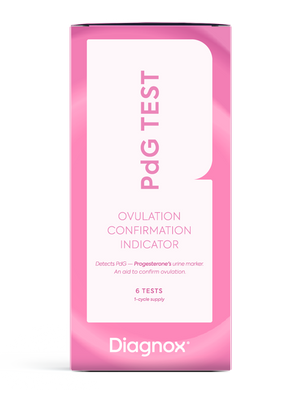
PdG Ovulation Confirmation Test
A regular period doesn't prove you ovulated. This at-home PdG test reads progesterone's urine marker, so you can confirm ovulation actually happened.

Early Detection Pregnancy Test
No more squinting at faint lines. This FDA-cleared early detection pregnancy test gives a clear + or - result, up to 6 days before your...
Questions
The ones we hear most often.
