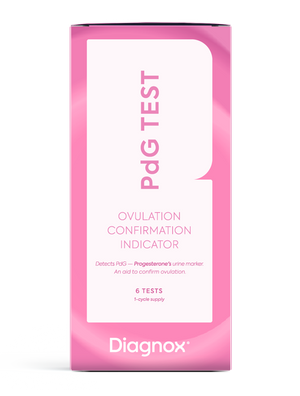
PdG Ovulation Confirmation Test

Sixteen readings from one strip. We're here to help you work out which ones matter.

Reviewed by a member of our support team, not software and not a clinician. Reply within one business day.

PdG Ovulation Confirmation Test

Read your result

What your result might look like.

This test reads opposite to most. One line is positive and two lines is negative — 
worth reading twice before you decide what you're looking at.

  • Positive

    Positive

    One line — C only

    What it means

    One line means high PdG. This test reads opposite to most: a single control line is the positive result. Progesterone rose around five days ago, which means ovulation likely happened about then.

    What it doesn't mean

    It doesn't tell you when to try to conceive — it confirms ovulation after the event, not as it happens. It isn't a pregnancy test and it isn't contraception.

    What to do next

    Note the date. If you're tracking across a cycle, test at the same time of day so the results compare.
  • Negative

    Negative

    Two lines — C and T

    What it means

    Two lines mean low PdG. A visible test line counts as negative however faint it looks against the control line.

    What it doesn't mean

    A low reading on one day doesn't mean you didn't ovulate at all. PdG rises and falls through the second half of a cycle.

    What to do next

    Keep testing on the days your instructions set out. If your cycles are irregular or prolonged, talk to a provider about whether this test suits you.
  • Invalid

    Invalid

    No C line — or a T line on its own

    What it means

    Without a control line there's no result. The control has to be visible for the strip to have worked.

    What it doesn't mean

    It isn't high PdG and it isn't low PdG. It's a strip that didn't run.

    What to do next

    Use a new strip. If it fails again, get in touch and have the lot number to hand.

Send us a photo

Second-guessing the line count?

Given this test runs backwards, it's the one people most often want checked. If you're looking at something very faint and can't tell whether it counts as a line at all, send a photo rather than deciding alone.

01

Photograph the whole strip with the window in frame, flat on a plain surface.

02

Take it between 5 and 10 minutes. After 10 the result may be inaccurate, whatever it shows.

03

Daylight if you can, phone straight above, no shadow across the window.

How this works

Your photo is reviewed by a member of our support team. They are not healthcare professionals and cannot diagnose a condition or advise on treatment. What they can do is help you read what your test is showing.

Nothing here is automated. Your photo stays confidential and is used only to answer you.

Upload your photo

When to test

Testing on the wrong days is the most common reason this test says nothing.

PdG takes about five days to build up after ovulation. Test before that and you'll get a negative that means nothing at all.

Start day = cycle length − 12

Day 1 is the first day of your period. Cycle length runs from that day to the day before your next period starts. Using an ovulation predictor kit instead? Start five days after your peak.

Find your start day

  • Cycle 26 Day 14
  • Cycle 27 Day 15
  • Cycle 28 Day 16
  • Cycle 29 Day 17
  • Cycle 30 Day 18
  • Cycle 31 Day 19
  • Cycle 32 Day 20
  • Cycle 33 Day 21
  • Cycle 34 Day 22
  • Cycle 35 Day 23
  • Cycle 36 Day 24
  • Cycle 37 Day 25
  • Cycle 38 Day 26
  • Cycle 39 Day 27
  • Cycle 40 Day 28
  • Cycle 41 Day 29
  • Cycle 42 Day 30

Then

  1. 01 One test each morning, at roughly the same time, using first-morning urine.
  2. 02 Stop as soon as you get a positive. There are six strips in the kit, which covers a cycle.
  3. 03 Missed a morning? Pick it up the next day. One gap won't spoil the picture.

If you test through a whole cycle and never get a positive, stop and talk to a provider rather than buying more strips.

Some people don't metabolise progesterone into PdG at levels this test can pick up, so repeated negatives can mean the test isn't reading you rather than that nothing happened. Irregular or long cycles are worth that conversation too, before you spend another month on it.

Taking the test

A few things worth knowing first.

Start with whether this test is right for you at all.

This test isn't suitable if you're taking any of these.

  • Hormonal birth control — pills, patches, rings or hormonal IUDs 
  • Progesterone medication — pills, creams or suppositories 
  • Hormone replacement therapy

  1. First-morning urine, every time. It holds the highest level of PdG. Using urine from later in the day can give you an inaccurate result, and it's the single easiest way to waste a strip.
  2. Collect into a clean, dry plastic or glass container. This is a dip strip, not a midstream test.
  3. Use the strip within an hour of opening the pouch. Longer than that and it isn't reliable.
  4. Alcohol can affect the result, and so can anything containing progesterone. Check the leaflet for any medication you're on.
  5. You'll need a timer. The kit has six strips, the manual, and nothing else.
  6. Store the strips sealed between 4 and 30°C, out of sunlight, away from moisture and heat. Don't freeze them.

Directions for use

How to take it.

About ten minutes, five of it waiting.

  • STEP 01

    Dip

    Hold the strip upright and dip the white tip into your first-morning urine for at least 15 seconds, until the dye rises into the window. Don't go past the MAX line.
  • STEP 02

    Wait

    Lay the strip flat on a clean, dry surface and leave it alone. Five minutes is the earliest it can be read.
  • STEP 03

    Compare

    Read between 5 and 10 minutes, and count the lines. One line is positive. Two lines is negative.

One line is positive. Two lines is negative. Read it between 5 and 10 minutes — not before, and not after 10. And keep the strip below the MAX line when you dip: submerging past it can stop the test working properly.

WATCH IT DONE

The whole thing, start to finish.

Questions

The ones we hear most often.

No — and you're far from the first person to ask. Two lines means negative on this test. One control line with no test line is the positive. It's backwards compared with a pregnancy test or an ovulation predictor kit because of how the chemistry works: the test line only shows up when PdG is low enough not to compete with it. As PdG rises, that line fades away.

Any visible test line means negative, however light it looks next to the control line. Line intensity varies from person to person and cycle to cycle, so a pale line is still a line. If what you're seeing is so faint you genuinely can't tell whether it's there, send us a photo instead of calling it yourself — that's exactly what the photo review is for.

No. A positive means progesterone rose in your body about five days ago, so ovulation likely happened around five days before the positive. This test confirms ovulation after the fact rather than catching it as it happens. That's its job — it's the one thing an ovulation predictor kit can't do for you.

That's worth taking to a provider rather than working through another box. Two things can be happening. It may be an anovulatory cycle, where no egg was released and progesterone stayed low — these happen to most people occasionally. Or you may be someone who doesn't metabolise progesterone into PdG at a level this test can detect, in which case it will keep reading negative no matter how many cycles you try. A provider can tell those apart with a blood test; a strip can't.

No, and it isn't trying to. By the time PdG rises, the fertile window has already closed for that cycle. If you want to know when to try, that's an ovulation predictor kit, which looks for the LH surge beforehand. This test answers a different question: did ovulation actually happen this cycle.

No. This test is designed to work on its own. Basal body temperature and ovulation predictor kits sit alongside it well if you're already using them, but neither is required for a PdG result to mean something.

Still need help

 Talk to someone. 

No scripts, no phone tree. Whichever is easiest for you.

  • Running low

    PdG Ovulation Confirmation Test

    Six individually sealed strips — one cycle

    Learn more
  • Often used alongside

    Urinox-10 Urinalysis Test Strips

    Ten markers from one strip, including specific gravity

    Learn more

The PdG Test is a rapid qualitative test for pregnanediol glucuronide in urine, as an aid to confirm that ovulation has occurred. It is for over-the-counter in vitro diagnostic use. It does not predict ovulation or identify a fertile window, it is not a pregnancy test, it is not intended to monitor PdG during pregnancy, and it must not be used as a method of contraception. It is not suitable for anyone using hormonal birth control, progesterone medication or hormone replacement therapy, and medications containing natural or synthetic progesterone may cause false positive results. A PdG result alone does not give a complete picture of fertility. Consult a physician if your cycles are irregular or prolonged, if you consistently get negative results, or if you have any doubt about whether this test is right for you.